

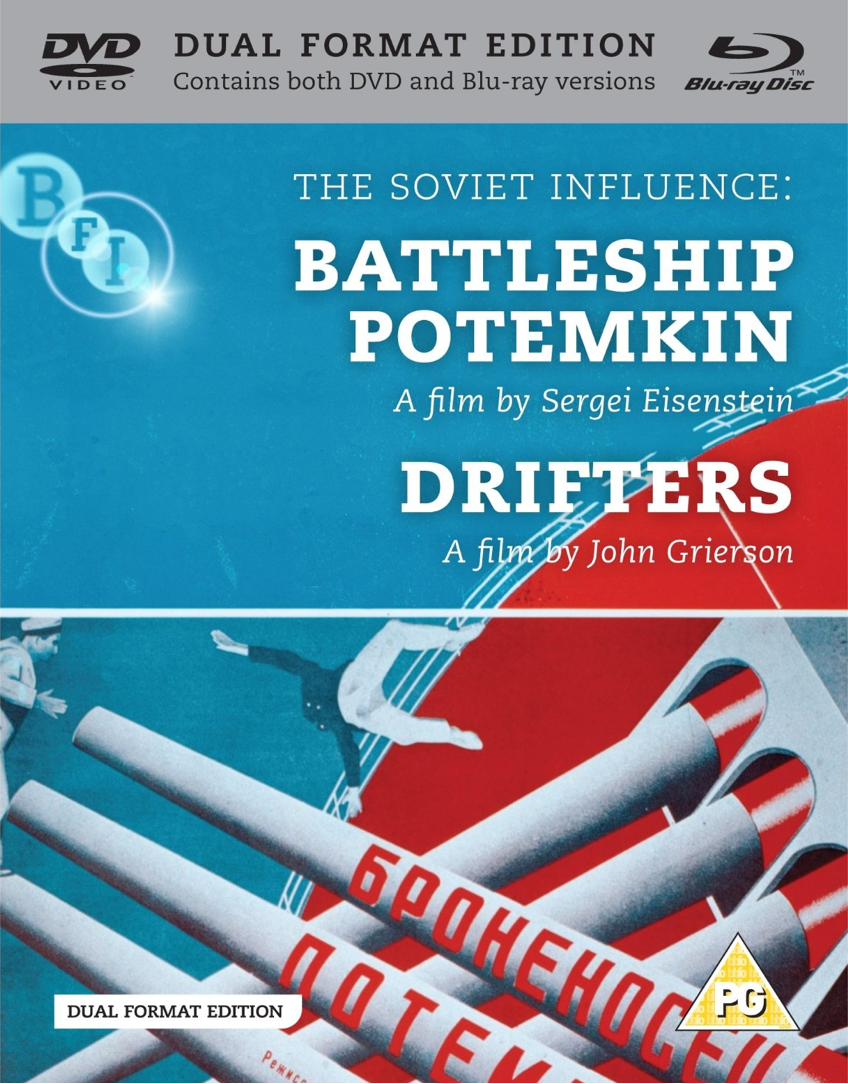
Sergei Eisenstein’s ground-breaking, propaganda masterpiece, ‘Battleship Potemkin’ (1925) was not seen in the UK until 1929, when it was screened on Sunday 10 November, at the Tivoli cinema in the Strand, in one of the most celebrated double-bills in film history. Now ‘Volume 2’ in the BFI’s ‘The Soviet Influence’ series once again pairs the Soviet masterpiece, one of the greatest achievements in the history of cinema, with the High Definition debut of John Grierson’s documentary, ‘Drifters’ (1929), and three other classic short films made by the GPO Film Unit, all clearly influenced by the work of the great Soviet master, Eisenstein.
Battleship Potemkin (Dual Format Edition) Blu-ray (Disc 1) / DVD (Disc 2)
BFI/Eisenstein/1925/Soviet Union
Running Time: 69 minutes
Region Code: Region B
Aspect Ratio: 1.33:1 (Original Aspect Ratio)
Video: Blu-ray: 1080p High Definition/BD50/ DVD: DVD9/PAL
Audio: Blu-ray: PCM 5.1 Surround/2.0 Stereo Audio/ DVD: Dolby Digital 5.1 Surround/2.0 Stereo Audio
Language: Silent, with Russian Intertitles
Subtitles: Optional English
Nearly 90-years on, Sergei Eisenstein’s silent masterpiece, arguably the most influential propaganda film of all time, and often cited amongst the greatest films ever made (though sadly just dropping out of the top ten list in the 2012 Sight & Sound Poll), has lost none of its visceral or emotional power, and now looks better than it has ever appeared, thanks to this newly restored blu-ray release from the BFI.
The film was commissioned in March 1925, by the State Jubilee Committee, as a piece of Communist propaganda to commemorate the twentieth anniversary of the failed uprising of 1905, which preceded the Russian revolution. They had originally intended to create an historical-propaganda epic titled ‘The Year 1905’, composed of six short episodes, however, Eisenstein saw greater potential in both the mutiny and the events in Odessa, which he felt could not be effectively condensed into one of the planned episodes, eventually leading to a film of greater scale, intense, emotional power and prominence.
Comprising five interwoven episodes: ‘Men and Maggots’; ‘Drama on the Deck’; ‘A Dead Man Calls for Justice’; ‘The Odessa Staircase’ and ‘The Rendez-Vous with a Squadron’, the film dramatises the ensuing rebellion that took place when the crew of the Russian ‘Battleship Potemkin’ (pronounced ‘Potyomkin’) mutinied against their officers of the brutal, Tsarist regime. Beginning on board the ship, the film vividly depicts the sailor’s protests at being forced to eat rotten, maggot-infested meat, moving to the wonderfully constructed, inevitable rebellion, and all culminating in the film’s most famous scene, the brutal massacre on the Odessa Steps, in which innocent civilians, including women and children, are horrifically shot dead by Tsarist Cossacks. What is depicted here is the ruthless and barbarous murder of innocent, defenceless and utterly helpless victims, with Eisenstein’s impeccably orchestrated, masterful direction and meticulous staging beautifully and effectively highlighting the contrast between the monstrous, Tsarist Cossack’s and the good, pure and humane citizens. This simple, yet intelligent and highly effective technique perfectly evokes a stirring, emotional response from the audience (one of the most potent moments of clear propaganda presented in the film), and, though the scale of the event was ultimately heavily fictionalised for the film, this sequence remains one of the most famous, affecting and most strikingly powerful sequences in cinema.
Eisenstein used the film to experiment with both the new film-editing techniques that had arisen from the revolutionary Soviet Kuleshov school of filmmaking and to test out his own theories of montage filmmaking, in an attempt to edit the film in a manner that would draw out the strongest emotional response from the audience. His intention was for the audience to develop a greater feeling of hostility towards the brutal Tsarist soldiers, in contrast with feelings of both heartfelt sympathy and empathy towards the rebelling sailors, and he brilliantly and effectively juxtaposes the two contrasting forces, further enhancing both the context and meaning, and the propaganda tone of the overall piece. Eisenstein’s influence and striking command is still prominently seen, and felt, in many of the works delivered to this day, and it is with ‘Potemkin’ that he proves a true master of the craft , delivering breathtaking, virtuoso direction and utilising innovative and revolutionary editing techniques to deliver a piece that has continued to develop its status as one of the most dominant and essential works in cinema.
This newly restored High Definition presentation of ‘Battleship Potemkin’ was taken from a 4K digital restoration undertaken by Transit Film, Germany in association with Omnimago Laboratories and runs at the the original speed of 18 frames per second, within a progressive 24 frame per second video presentation. The film is now 87-years old, so the transfer inevitably displays signs of age and damage, with white specks, vertical scratches, dirt and general debris prominent throughout the image, but though unfortunately emphasised in the High Definition transfer, they only seem to add to both the authenticity of the film, and the overall cinematic experience. Given the age of the film, and the damage inflicted on the source material, ‘Battleship Potemkin’ still looks astonishing in this 1080p, blu-ray presentation and there are tremendous levels of clarity, detail and contrast to be found in this release, wonderfully emphasising the beautiful cinematography of Eisenstein regular, Eduard Tisse. There are some moments where brightness levels are just a tad too high, but overall the contrast levels are striking and engrossing, with well rendered whites beautifully contrasting the deep, consuming, shadowy blacks. There are striking details to be found throughout the film, and though the wider and longer shots appear strong and clear, clarity is most prominent in the close up facial shots and images of the ship and the docks, with skin detail and tonal definition highly impressive, and textures and features of the ship and docks brilliantly highlighted, all wonderfully highlighting the capabilities of the blu-ray format. Thankfully, the restoration team have fully respected both the age and the historical context and significance of the film and have seemingly, wonderfully refrained from digitally removing damage inflicted by age, again maintaining an authentic feel to the piece. There do not appear to be any clear signs of digital manipulation or edge enhancement and there is a nice natural grain structure apparent throughout, adding a pleasing depth and textural quality to the film.
Eisenstein had originally intended for the film’s score to be re-written, or re-composed, every 20 years, in order to preserve the film’s significance as a piece of propaganda to each new generation, which is why, over the years, we have seen compositions from such varied artists as: Nikolai Kryukov (1950), Eric Allaman (1986) and the Pet Shop Boys (2004). However, thankfully, the most celebrated of the film’s scores, Edmund Meisel’s stirring, muscular and highly rhythmic composition, written for the Berlin premiere in 1926, and carefully constructed to meet Eisenstein’s specific vision, was considered the perfect accompaniment for this new HD restoration. A re-recording of Meisel’s wonderful score was commissioned by the Deutsche Kinemathek for the 2005 restoration, coinciding with the 80th anniversary of the film, and that is the recording that is presented here, in a performance by the Deutsches Filmorchestra Babelsberg, adapted and conducted by Helmut Imig. The blu-ray presentation features a PCM 5.1 surround mix and delivers a rich, crisp and immersive audio mix, with a strong dynamic range, offering excellent detail and texture, all beautifully capturing the majestic strings and striking percussion of Meisel’s soaring, expansive score.
Drifters (Dual Format Edition) Blu-ray (Disc 1) / DVD (Disc 2)
BFI/John Grierson/1929/UK
Running Time: 41 minutes
Region Code: Region B
Aspect Ratio: 1.33:1 (Original Aspect Ratio)
Video: Blu-ray: 1080p High Definition/BD50/ DVD: DVD9/PAL
Audio: Blu-ray: PCM 5.1 Surround/2.0 Stereo Audio/ DVD: Dolby Digital 5.1 Surround/2.0 Stereo Audio
Language: Silent
Subtitles: English Intertitles
Commissioned by Sir Stephen Tallents, head of the Empire Marketing Board, the pioneering Scottish filmmaker, John Grierson’s 1929, silent documentary, ‘Drifters’, announced the introduction of a new cinematic movement that would go on to dominate the British film industry for the ensuing decades.
In the first of only two features as a director (the second being the documentary short ‘Granton Trawler’ (1934), also included in this release), Grierson (often considered to be the father of the British documentary film) chose a subject he felt a great affinity towards, to depict the journey of a British North Sea herring drifter, from departure in Scotland, down the East Coast to market in East Anglia.
Grierson had previously overseen an English language translation for ‘Battleship Potemkin’ for the film’s American release, before the film was presented with ‘Drifters’ in the famous 1929 double bill, and Eisenstein’s powerful influence is clearly seen in Grierson’s debut feature. Like Eisenstein, Grierson incorporates many Modernist, Avant-Garde film devices, including the new editing techniques rising out of the Soviet film academies, and developing Eisenstein original experiments with montage to emphasise both the social commentary of the film and the carefully measured juxtaposition of images.
The film is enhanced by the wonderfully absorbing and inventive cinematography of Basil Emmott, brilliantly capturing the sensory experience and difficulty of life on the drifter, and who’s significant contribution and vast experience were critical to the film’s success. Emmott is sadly little known in the grand scheme of things, but with 190 films to his credit (120 of which were just in the 1930’s) in a career spanning over four decades, from the the silent, 1920’s and continuing through to the 1960s, he is arguably one of the most prolific of all British cinematographers.
The film is presented in a debut High Definition transfer, made from a 2K digital scan taken from an original tinted 35mm print, held by the BFI National Archive, and features the original 24 frames per second running speed and all the intended tints and tones. Again due to the age of the source material, there is a good deal of noticeable damage to the film and some minimal DVNR and MTI work has been undertaken to remove some of the most significant dirt and damage. That said, the digital manipulation is only minimal and does not distract from the raw, sensory power of the film, and the blu-ray transfer offers very pleasing levels of clarity, with crisp textures and details, good tonal definition and nicely rendered levels of contrast, delivering an immersive and compelling presentation of this important and revolutionary piece of filmmaking.
In terms of the audio presentation, the BFI commissioned the British composer Jason Singh to provide an evocative new score to the piece, all created vocally by Singh, and manipulated using digital music software and effects. Singh has definitely thought about the new score, and he delivers an intriguing, emotional and slightly eerie composition, cleverly complementing the power of the original film, without ever turning the focus onto him or detracting from the absorbing visual spectacle.
Special Features:
Granton Trawler (John Grierson, 1934, 11 mins): Grierson’s follow up to Drifters, one of the GPO Film Unit’s first experiments with sound
Trade Tattoo (Len Lye, 1937, 6 mins): celebratory animation made from off-cuts of EMB and GPO films, including Drifters and Night Mail
North Sea (Harry Watt, 1938, 32 mins): dramatic reconstruction of sea farers battle with the elements, produced by the GPO Film Unit
Fully illustrated booklet with credits and essays by Henry K Miller, Patrick Russell and Michael Brooke
Overall:
A stunning presentation of one of the finest, most important and most influential achievements in the history of cinema, beautifully accompanied by the film it was originally presented with on its UK debut and other British GPO films influenced and inspired by the visceral power of Eisenstein’s ground-breaking, ‘Potemkin’.
Release date: 5 November, 2012
Pre-order Blu-ray now (click image to buy):

